Jetstar History

Jetstar Prototype, N329J, in its final Lockheed color scheme
Herewith, some Jetstar historical photos, courtesy of Jim Goodall and his friends at the Lockheed Skunk Works

The Prototype Jetstar under construction at Burbank, with Kelly Johnson in the foreground, facing camera. Note the production crew, breaking for lunch, under the airplane!
The first two airplanes, N329J and N329K, were built in Burbank. All the remaining airplanes were built at Lockheed's Marietta, Georgia plant.
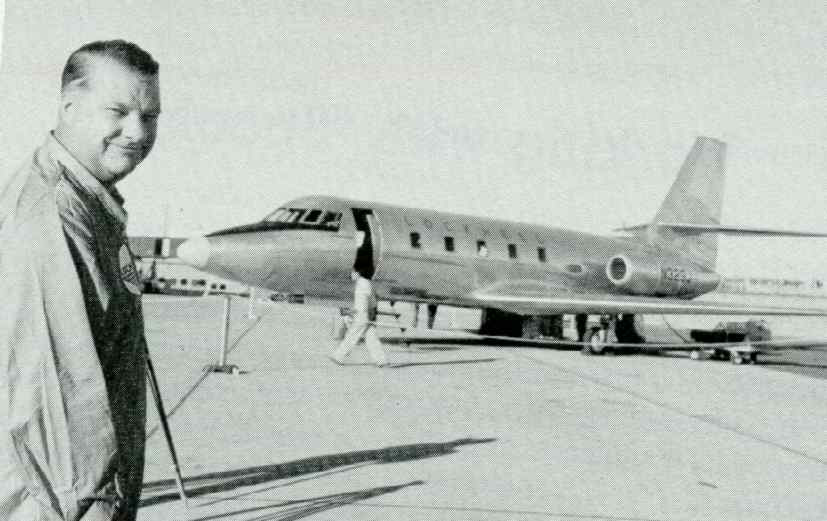 Kelly, and his new airplane
Historic Photo - taken at Edwards AFB before First Flight - 4 Sept 1957 Crew for the First Flight: Ray Goudey - Captain - Left Seat
Bob Schumacher - Copilot - Right Seat
Ernie Joiner - Flight Test Engineer
More about Ray here
 Close-up of participants
Bob Schumacher - Co-Pilot for First Flight
Ernie Joiner - Flight Test Engineer
Kelly Johnson - Designer and Head of Lockheed Skunk Works
Jim Wood - Edwards AFB Flight Test (USAF)
Tony LeVier - Pilot of P-80 Chase Plane
See the original Data Plates and Certificate of Airworthiness here

 An early photo
Note: Single nose and main gear wheels, no slipper tank, new color scheme - one of several (quite a number, actually) used on the airplane.
 Classic takeoff from Burbank, Connies in the background
 Flying over Southern California mountains
 First two Prototypes in flight
Note: Both with twin engine Bristol Orpheus installations. There were only four Orpheus engines ever made - all four flying in this photo (see below.) N329J Prototype in forground, wing slats extended, no slipper tanks. N329K - second airplane in back, slats up, slipper tanks installed. Second airplane later retrofitted with standard JT12 four engine installation. First airplane retained its twin configuration throughout its life. Slipper tanks from No. 2 were retrofitted to No. 1 when No. 2 got the four engine installation, along with a new, larger slipper tank configuration. Ultimately, there were three slipper tank configurations. Paint scheme # 3, of many. See some of the paint schemes here.
 The standard 4 engine configuration - P&W JT12 engines
 The final production configuration
Marketed as the Jetstar II, with four Garrett TFE-731 turbofan engines. Many similar after-market conversions.
 An Ooops!
This photo of the aircraft being craned is obviously at an off airport location. I'm unable to find any records of this in the NTSB accident database, which extends back only to 1 Jan 1973.. (Perhaps we can get some Lockheed old-timers to shed some light on this.)
I was able to locate engine teardown reports from Bristol; they pinpointed the accident date as 28 April 1962. The airplane had been flying about 90 minutes at 40,000 feet. During descent and approach to Burbank, only 50% thrust could be obtained, and the fuel boost pump pressures were noted as zero. Unable to make the field, the airplane was force landed in an open area. The engines continued to run at idle power throughout the landing.
The teardown reports can be seen here.
The
above picture has generated quite a lot of fascinating emails.
They discuss who the pilot was that was flying, as well as the exact
location of the accident:
Bob,
I saw the aircraft flame out and land in a field near Burbank.
Herman "Fish" Salmon, Lockheed test pilot and friend of mine, came by my house and we went together over to the aircraft. The airplane ran out of fuel or lost power just short of Burbank. The emergency landing, off airport, in 1962, was actually due to a design problem. The fuel supply froze. The pilot of that flight was Vern Peterson. He broke his back in the accident. After returning to flight status, he continued in flight test including the test program for the C-130 and C-141.
Hi Bob,
I enjoyed your website. My name is Michael B; I'm a dentist in Los Angeles, CA. My father was Charles I. B MD, who was medical director at Lockheed in Burbank from about 1950 on for over thirty five years. He was very active in aerospace medicne and of course was intimately involved with all of Lockheed's test pilots during the development of its many aircraft designed by Kelly Johnson. I have always been interested in flying and the history of flight. I have a private license but have not been an active pilot in a number of years but I do have great interest in anything flight related. I'm contacting you because I came across a webpage from you regarding the Lockheed Jetstar. You show a picture of the aircraft being craned out of a field from an off airport landing in 1962 stating that it was near the Burbank Airport. I was in 11th grade at the time and was working in our backyard in our family home in Northridge, CA. I saw the aircrft fly in from the West over our house flying very low heading toward Van Nuys. Of course I recognized it as a Jetstar. The plane turned South and then back West (South of our house) and went down below my visible horizon. I quickly got my dad out of the house and we drove to the crash site. The pilot had landed in a plowed field (developed shopping center today). I'll never forget seeing the length and depth of the furrows that the main gear left in the field (I think that he did have the gear down). What irony that one of the first people at the crash site was Lockheed's medical director who also happened to be an expert in aircraft accident investigation! I also recall that the pilot, Vern Peterson, lived in our area. Maybe he had prior knowledge of the condition of the plowed field. Interesting that you think that the NTSB has no record of this incident. I enlarged the photo of the Jetstar crash and I recognize the Santa Suzana hills in the background verifying that this was the same Northridge crash that I witnessed from my house. It was not near Burbank or Sunland but actually west of the Van Nuys airport. Fish Salmon probably did visit the crash site as his house was also in Northridge close to ours. I spent many hours with him in his garage rebuilding my old Matchless motorcycle.
Please let me know if you received my email; I'm a real fan of aviation history, especially regarding Lockheed. Via my dad I had the honor of meeting Tony Levier, Fish Salmon, and even Col. John Stapp of the rocket sled fame.
Regards,
Michael B. DDS
You can see the location here.
As I was a good friend of Bob Schumacher’s son (Paul), I can tell you that Bob S. was flying the JetStar that made the Sunland ‘off field’ landing. Bob is the one who broke his back, effectively limiting and ending his ‘company’ flying (U2 and SR-71). Bob Schumacher ended up flying a Convair 240 that went from Burbank to Beale AFB to Tonopah everyday (with the SR-71 Technicians). I ended up being stationed at Beale (KC135Q) and I would hop a ride home with Mr. Schumacher every Friday. If my brain can think of more stories I will be glad to email you.
More information:
Following the accident, Fred Cavanaugh, Advanced Development Projects engineer, authorized installation of the production (dual wheel) nose gear. The landing took place with the gear down, with the resultant failure of the original nose gear. (The Jetstar originally had single wheels on all landing gears. The production airplanes had dual wheels on each landing gear. After the accident, the Prototype wound up with the unique configuration of duals on the NLG and singles on the MLG.)
 Kelly and crew
This photo is labeled "Last Day of Senior Bowl". Kelly is seventh from
left, and a lot older. Senior Bowl refers to the Skunk Works D21 ramjet drone program. See: http://www.wvi.com/~sr71webmaster/d21b001.html
(Thanks to Eric Toler for this info.)
Kelly and crew
This photo is labeled "Last Day of Senior Bowl". Kelly is seventh from
left, and a lot older. Senior Bowl refers to the Skunk Works D21 ramjet drone program. See: http://www.wvi.com/~sr71webmaster/d21b001.html
(Thanks to Eric Toler for this info.)
N329J in her final (and current) paint scheme Note the dual nose wheels and the slipper tank off No. 2 airplane. See N329J today

Comments and more photos or information? - write me.
The pilot of the first flight, Ray Goudey, was also the pilot for the last.
The following directly from Ray, to Jim Goodall, in response to this webpage:
Engines
According to correspondence found in the records we received from BCIT, from Bristol Siddley to Lockheed in 1963, they remind Lockheed that they had the only four Bristol 810D engines in existence! Serial numbers 130001, through 130004. Thus, they were cautioned, due notice was needed by the factory when overhaul times were close as they may have to manufacture components for the engines. At the Museum, we have three of these, the fourth (004) being the one that came apart on takeoff from Burbank.

Tom Cathcart

See more engine information here (pending)
© Copyright 2006 - 2010 Robert A. Bogash. All Rights Reserved
Comments and more photos or information? - write me.
Ray Goudey and Alan Brown comments via Jim Goodall.
Return to Home Page
Revised 1 May 2006
18 May 2006
19 May 2006
21 May 2006
11 Jun 2008
5 Dec 2010