Holland "Dutch" Redfield
"The Final Touchdown"
During a lifetime in aviation, I have experienced only one forced
landing. It was not difficult. The dead-stick glide began at three
thousand feet. There were several suitable fields from which to choose.
Things worked out nicely. Yet I know that I have one more forced
landing lurking and waiting for me out there. I believe that at this
stage of my life, I am ready for it. Perhaps there will be warning,
maybe not.
Will there be time for me to plan a good approach to this final
touchdown? Will it be a hasty no power, no options, straight ahead
steep descent to a walloping hard touchdown? Or will it be a soft
afternoon peaceful glide?
Whatever, for this final glide, I ask only for an open cockpit, so I
can, however briefly, savor for the last time the feels of flight, as
biplane wings forward of me exquisitely frame and record the slowly
changing, tilting scenes as I maneuver and silently bank and glide onto
what I have long known will be my very final approach.
Please, no helmet, so old ears can best sense vital changes in speed,
relayed through the lovely sounds of whistling interplane struts and
wires, and so cheeks and bared head can best read changing airflows
swirling behind the cockpit's tiny windshield.
Below, in a forest of trees lies a grassy field long ago set aside for
biplane flyers of old. It looks small, tiny. With lightly crossed
aileron and rudder I'll slip her a few inches over the fence. I'll
level her off, then hold her off, with wheels skimming the grass tips.
The lift of the wings, the sounds of flight, rapidly diminish. With
stick full back, lift fades, a slight tremor, then she and I are
bumping and rolling across the beautifully sodded field. The wooden
propeller remains still.
We roll to a stop. I have no belt to loosen. I raise goggles and slowly
climb out. Suddenly there is applause, then bear hugs and slaps on the
back. "Hey, you old goat, you really slicked that one on!" I am with
old friends.
Dutch Redfield
Dutch passed away in his sleep on November 13th.
Holland 'Dutch' Redfield
1916-2008
Holland "Dutch" Redfield of Nassau Point, a former airline training
captain, sailing enthusiast and most recently a resident of The Shores
at Peconic Landing, passed away Nov. 13.
He retired from Pan American World Airways as Atlantic Division chief
training captain in 1976, after 33 years totally devoted to pilot
training. Prior to joining the airline, he operated his own seaplane
flying service in the Adirondack mountain and Thousand Islands areas of
upstate New York. He learned to fly in Syracuse, N.Y., in 1931.
Mr. Redfield was one of the founders of the Setauket Yacht Club in Port Jefferson and later served two terms as commodore.
He was also a member and officer of Eastern Sailing Club, the Quiet
Birdmen, Long Island Early Flyers and the PanAm Clipper Pioneers. In
1946 he authored a book entitled "Instrument Flying and Radio
Navigation;" in 1981 a second, "Thirty-Five Years at the Outer Marker;"
and in 1995 a third, "The Airman's Sky Is Not the Blue."
In 1969 he was in the first group, and became the fifth airline pilot
in the world, to be qualified on the Boeing 747 in Seattle, Wash.
"Dutch" is survived by his sons Charles, of Kansas, and Holland II, of
the U.S. Virgin Islands; his daughter-in-law Geraldine, of Florida;
granddaughters Kristen Hughes of Florida and Amanda Redfield of North
Carolina; and great-grandchildren William and Margaret Hughes.
Memorial visitation was held Sunday, Nov. 16, at Coster-Heppner Funeral Home in Cutchogue.
"The Final Touchdown" was read at Dutch's funeral service.
Postscript:
When I first sent this out to some of my friends via email,
I got two replies. One from Lew Wallick, retired Boeing
Test Pilot who said Dutch has been one of his students; and one from
Tom Hatch, retired Pan Am pilot, who said Dutch had given him check
rides in the 707. A small world.....
Dutch was a long-time National Waco Club member .
Check out this YouTube video and read about Dutch's Waco flying:
http://www.youtube.com/watch?v=qJU6SWcSxr0
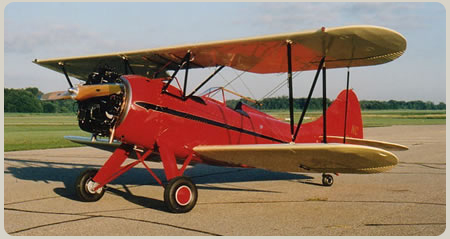 Waco UPF-7
Waco UPF-7 was a dashing war hero. Well, we're not sure it was a
hero, exactly, but it did serve almost from its birth in 1940 as a
training aircraft for the Civilian Pilot Training Program (CPTP). And
Wacos often did the most glamorous training in that program, like
aerobatics. The purpose of the program was to provide a pool of pilots
in the event of war.
The CPTP was glamorized by Hollywood in the 1939 movie 20,000 Men a Year.
The film served to fire the
imaginations of college students who were recruited for the program.
CPTP — an instructor's perspective
Former CPTP instructor, Holland L.
"Dutch" Redfield, included an account of his days teaching
aerobatics in a similar Waco UPF-7 aircraft in his book, Thirty Five
Years at the Outer Marker. Although the book is out of print,
photocopies may be obtained through a Web site (www.geocities.com/vmken/BookRedfield.html).
Redfield, who at the end of his career was teaching Pan American
pilots to fly the Boeing 747, loves the Waco UPF-7 to this day, saying
that it is built like a brick structure of high utilitarian value — his
description was shorter. To quote Redfield, he loves "the open cockpit,
the magnificent radial engine, the large disk'd propeller, the control
stick between the knees — I am pleased." He describes the sound of the
giant propeller with the engine at idle power. "A slow rhythmic whish
whish whish whish whish — like the beat of a swan's wings in flight�."
Redfield describes the UPF-7 as a tough, rugged airplane, built to
rigid military trainer standards and therefore lacking the nimbleness
of other Waco models. "But you didn't have to worry about the UPF-7
falling apart under the high stresses of the advanced aerobatic
maneuvering that was called for in the course program."
Seven days a week
It's a good thing Redfield liked his airplane, because he spent
seven days a week in it. "Working with my six students, I might spend
the entire day Monday, hour after hour, doing exacting eights around
pylons; Tuesday, beautiful chandelles; Wednesday — all day — snap
rolls; Thursday, demanding slow rolls; Friday, punishing split S's;
Saturday, half-rolls; Sunday, Immelmanns." His role as a CPTP
instructor lasted through three years of the early 1940s and 1,900
hours of flight.
Not all of those hours were placid ones. Hearing from his boss about
a "square loop," Redfield decided to try one. As he applied negative
Gs, the engine quit while the UPF-7 was nearly vertical. "The airstream
sounds of flight and the whistling wing-brace wire sounds rapidly
diminished to absolute silence, and we hung there like a spent arrow.
Cows mooing, dogs barking, train whistles, and auto horns beeping below
could be clearly heard. Still we hung there, pointing straight up,
despite everything I tried.
"It seemed forever before the Waco slowly started sliding backwards,
and then, with a resounding, neck-bending crash, flipping violently end
for end, in a split second it was pointed straight down. As we dove for
the Earth the dead propeller ahead slowly began turning again, and the
sounds of flight came alive. Clank, clank, clank, clank, clank, and the
engine windmilled back to life. My student in the cockpit behind banged
the coaming and yelled, 'That was fun. Let's do it again!'"
Above narrative by Alton K. Marsh from AOPA Magazine August 2002.
Links
Waco UPF-7 Story
Return to Stories Page
Return to Home Page
Copyright 2008 Robert A. Bogash. All Rights Reserved.
Video, Dutch's Poem, and AOPA article Copyright their respective copyright owners.