Page 2 - Jets

Bob
Bogash
| Idlewild - JFK - 1957 - 1968 Page 2 - Jets |
Bob
Bogash
|
|---|
| Home Safety Index Reader Comments Contact | ||
The
years 1959 - 1962/63 marked a huge change at Idlewild (and the rest of
the world's major airports.) The conversion of the world's air
commerce was dramatic and remarkably fast. Within maybe 24 months - it went from this..... to this  as Boeing and Douglas cranked out 707s and DC-8s, that filled the skies...  ....and filled the major airports  An interesting photo In October 1958, in a bit of a race, BOAC with the Comet, beat Pan Am with the 707, to be the first to inaugurate jet service across the Atlantic - by a week or two. And here I captured the two of them together.  The Comet IV was the
result of about 6 years of development that resulted from early
accidents involving the Comet I - the world's first Jetliner.
A beautiful and pioneering aircraft, the Comet had but a short stay on the world's airliner stage.Some say Boeing was able to benefit from the early Comet's weaknesses and so took advantage of the Comet's pioneering efforts. That's not really true as the Comet's basic weaknesses lay in its configuration. In a nutshell, it was too small, too slow, and too short-ranged. While Boeing and Douglas addressed some of their initial product short-comings in continual new models, deHavilland did not, or was unable - engineering-wise, and financial-wise. The body was too
narrow resulting in too few passenger seats, negatively impacting the
economics. Boeing widened the 707 body - not once, but twice,
first to satisfy USAF, and then to satisfy American Airlines, match the
DC-8, and give six abreast seating.
See my history of the 707 by clicking here.The wing was too fat and had inadequate sweep back resulting in a slower and shorter ranged jet. (Wing sweep - Comet- 20 degrees; DC-8 - 30 degrees; 707 - 35 degrees.) The engine location was problematic as well, including maintenance reasons, but greatly impacting landing gear location and fuel capacity. When jet engines first
arrived on the scene during WW II, and thereafter, there was great
confusion over where to put them; and where to put the landing
gear. First
attempts were to put them - engines and gear - where they
had been on propeller planes - on and in the wing. Airplanes like the B-45, XB-46 and XB-48 were examples.
Many early (and some
later jets) went for the "buried engine" approach. The Comet was
one example - so were the British Victor and Vulcan bombers, and the
Soviet TU-104 and TU-124. Buried engines usually resulted in
landing gear that had to be retracted into the wing - like the Comet and
the Tupolev's. The result for the Comet was a "fat wing" which
was aerodynamically slower, weighed too much, and which gave up wing
fuel storage space - hence negatively impacting range. Probably gave birth to the "slipper tanks" to regain fuel volume.
Boeing solved all
these problems by hanging the engines on pylons on the wing (which
provided many benefits, including wing bending relief), and buried the
landing gear in the body. This approach was developed for the B-47
(one of the world's most significant aircraft designs), and then used
on the B-52 and finally on the 707 series. Actually, it became the
semi-standard configuration for many of the world's airplanes,
including those from Douglas, Convair, Airbus, and the Russian design
bureaus.
You can read about these developments in my B-47 page - click here. The end result was
most airlines that flew the Comet - like BOAC, Olympic and Aerolineas
Argentinas - quickly migrated from the Comet to the 707.
Actually, BOAC saw the writing on the wall early, and ordered their
first 707s in 1956 before their Comets even entered service in 1958.
Back to JFK Jets.... May 16, 1959 was an
exciting day for me and my pal Paul Nevai. We had hitch-hiked out
to Idlewild to see what we could see. And we saw our first
Jet! The "Jet Age" was barely 6 months old, and we happened upon American 707 N7503A parked on the ramp in front of the American hangar.
 Fences and restrictions having little effect in those days, we crossed the ramp for a closer look.   It turns out this airplane made American's first transcon jet flight 25 January 1959: “The Jet Age” opened when American Airlines began the first scheduled transcontinental passenger service with its new Boeing 707-123 Astrojet. Captain Charles A. Macatee III flew Flagship California, N7503A, from Los Angeles International Airport on the coast of southern California, to New York International Airport ¹ in New York City, in 4 hours and 3 minutes. Soon, Jets filled the ramps.  QANTAS in later marking and a BOAC VC-10 - more on them later... Tail mounted engines were another alternative to wing pylons.   A few years still later, and 727s, Convair jets, and DC-9s had joined the mix  PAA DC-8 with propliner behind   BOAC Britannia - about to disappear into aviation history .... followed by the Comet   BOAC 707s replaced the Comets   Flights to the West Indies and Caribbean as well as to Europe and California. Like Malaysia-Singapore Airlines (MSA), BWIA (BeeWee - or British West Indies Airline), which was the joint airline of numerous Caribbean islands and nations, splintered when individual national airlines were formed - like, e.g. Air Jamaica.  An Air Jamaica DC-9 I photographed at Montego Bay  Bahamas Airways BAC-111 at JFK  One reason that an airport like Idlewild was impacted so severely early on was because most of the early jets were aimed at the longer range more lucrative routes. So smaller airports, like LaGuardia and Newark, which catered to medium and short haul services, did not see jet aircraft designed and produced until the next generation of Jetliners (Caravelle excepted at EWR.)  ... a lot of evolving color schemes and paint jobs also... Eastern DC-8   A lot of the new paint jobs were a lot worse than the old ones! My opinion...  720 720 Actually, it was thought by many at the outset that jets would be used exclusively for long haul trans-con and international flying. Medium and short range flying would remain the realm of prop airliners - gradually transitioning from piston engines to turboprops. The problem (if that's the right word) is that once passengers tasted the quiet and smoothness of the jet ride, there was no going back. It would be like going back from color TV to Black & White (Yes - there was not always color TV, for you younger readers.)    Convair 990  727  Varig 707-420 (Rolls-Royce Conway engines)  A Qantas 707-138 (short fin, short body, and pre-fan conversion) with BOAC DC-7C and Britannia behind. (VH-EBG). Boeing built only 13 -138s, especially for Qantas - shorter even than a 720. I photographed this one in 1959. A Good One! I photographed this same aircraft again at JFK in 1968, this time with the fan engine conversion and the vertical fin mod, after being sold to British Eagle 13 Mar 1968  British Eagle went
bankrupt 6 months later, and the airplane went to Laker, and then a long
list of other operators. It may still be active today flying as
the Presidential aircraft for the Democratic Republic of the Congo. It has an
extremely interesting history (which is why I like tracking this
"stuff"), which can be found by clicking here.
Speaking of Laker,
here's a 707-138B ex-Qantas sistership that I photographed at JFK in
1968 that also passed from Qantas through British Eagle and then on to
Laker. It also had an interesting, albeit much shorter history,
being scrapped at Paris Le Bourget in July 1983.
  Another good one - Panagra DC-8 Hal Hemke, one of my early Boeing bosses, started out working for Panagra in Lima, Peru, where he met his future wife Iola.  Avianca 707-320B HK-1402 at JFK - 1968 Trips I flew aboard this aircraft included JFK to Bogota on 24 May 1968 It was part of a project I was assigned to - we were preparing to fly the Pope to Bogota for an ecumenical congress  On 22 Aug 1968, we flew Pope Paul VI on this aircraft non-stop from Rome to Bogota.  Airplane landed at El Dorado Airport at 10:19L after 11 hr 45 min flight. More than 50,000 people were at the airport for the arrival. More than 500,000 lined the road into the city. I have a future photo web page planned for this little career adventure. Click here for my somewhat similar adventure flying the Queen. British Overseas Airline Corporation - BOAC - was a major 707 operator, although they won the trans-Atlantic jet race against Pan Am by about 2 weeks with a Comet IV.  Initially flying Rolls-Royce Conway powered 707-400s which replaced their initial Comets.   ...later, Pratt powered 707-320B and C's and VC-10s    A really fine picture of a really beautiful flying machine. Pat yourself on the back for that one, Bob!  And one more good one - a Five-engine VC-10 (with Fifth Engine Pod)!!  A 1968 JFK pic of a VC-10 with another operator - BUA  The similar Russian IL-62 was equally good looking Note the little pogo landing gear at the back end. I have another story about that too! For another day....    VIASA was the Venezuelan airline - also serviced the Dutch Antilles They worked with KLM flying DC-8s and CV-880s  Military While I was the Boeing Rep based
at Pan Am Hangar 18, I got to see a lot of unusual equipment. Pan
Am had a large hangar complex there and a huge ramp and acted as sort
of an FBO for the World. The RAF (Royal Air Force - UK) used them a lot.
 Britannia  Comet  VC-10  ... and even a Belfast! The Russians are coming, the Russians are coming....
A number of times, we got a real treat - a Russian airplane landed at JFK at a time when such operations were more akin to Martians landing here.  This
TU-104A landed at IDL - CCCP-L5445 - in September
1959. It was carrying Soviet Foreign Minister Andrei
Gromyko, and had made stops in London Heathrow and Keflavik.
Wikipedia says the Port Authority refused authorization due to noise
concerns, but you can see something resembling the airplane in question
in the photo I took, so score one more for Wikipedia! Many
consider the TU-104 the first successful jetliner, after the Comet was
withdrawn from service, although it too was eventually grounded due to a
poor accident record. Note the crowd of ground workers looking at
the airplane.
 Next up was the incomparable TU-114, one of the largest airplanes ever built. It was based on the Russian TU-95 Bear Bomber, which is still in-service. This photo was taken from the IAB Observation Deck and is believed to be about June 30, 1959, having brought Khrushchev non-stop from Moscow to the UN for his shoe banging performance. It was so tall that the airport steps could not reach the door, and an aluminum extension ladder had to be used on the top steps of the mobile stairs. Its arrival and presence were well advertised and drew folks like me like a bear to honey.  In the
background, you can see the Pan Am umbrella/parasol terminal under
construction. In the early 1960s, a series of unique terminals
were built around the Idlewild Terminal core, each designed and specific
to a major airline tenant. This terminal was certainly unique -
Pan Am called it the Worldport - and it can be seen in a number of my
photos. It has since been torn down (along with all the others -
except TWA) and replaced with more modern, monolithic structures - which
are now also being torn down, to be replaced by even "more modern",
more monolithic structures.
 Here the terminal can be seen after completion  V.I.P.'s - and the UN Besides being a
commercial and financial center, New York was also home to the UN and
periodic conferences and meetings brought a huge array of never seen
airplanes - many normally "banned" from the U.S. (e.g. Cubana and Castro.) They all parked
on the Pan Am ramp and were fair prey for me in 1968 with my camera and
ramp access.
 Air Force One was a frequent arrival  One day, this IL-18
(Russian Electra) showed up. It was carrying Russian leader
Leonid Brezhnev to a UN meeting. After the arrival formalities,
the airplane was left on the ramp for a few days. There was no
security. One day, there were steps up to the airplane and the
door was open, and nobody around. So - you know me - I invited
myself on-board. I was surprised at the totally non-VIP interior
that could be best described as very spartan. Of course, there was
the usual Moskva household refrigerator in the galley; it was a fixture
on many Aeroflot airplanes that I visited (or flew on.) The rest
of the airplane was a standard one-class coach interior. The only
VIP feature was a circular sofa in the very back (like an Eastern DC-8)
which surrounded a standard K-Mart style kitchen dining table,
complete with chrome frame and legs and a Formica top. I guess
that is where the General Secretary of the Central Committee of the
Communist Party of the Soviet Union rode. A lot different than Air
Force One!!!
 The Russians had jet transports at this time, so I was surprised the Head Man was riding around in this beater. But this was the only airplane that arrived for the occasion.  On another occasion, they brought in this IL-62. Surprised he didn't ride in it for the first trip. The Russian VC-10 was also a good looking airplane  Another IL-18, this one from Romania  An early Braniff 707-220 - only five were built; one was lost in a training accident at Boeing. They had more powerful engines from the -320 (JT-4s) on the smaller -120 airframe. Braniff flew out of many high altitude airports in South America and wanted the extra thrust. Later Braniff's can be seen here below.  DC-8-62  A Blue DC-8  A Blue 707  I have a whole story about the above 707 - too long for this web page. My Field Rep "Baptism by Fire" or How to get Fired on your Third Day!  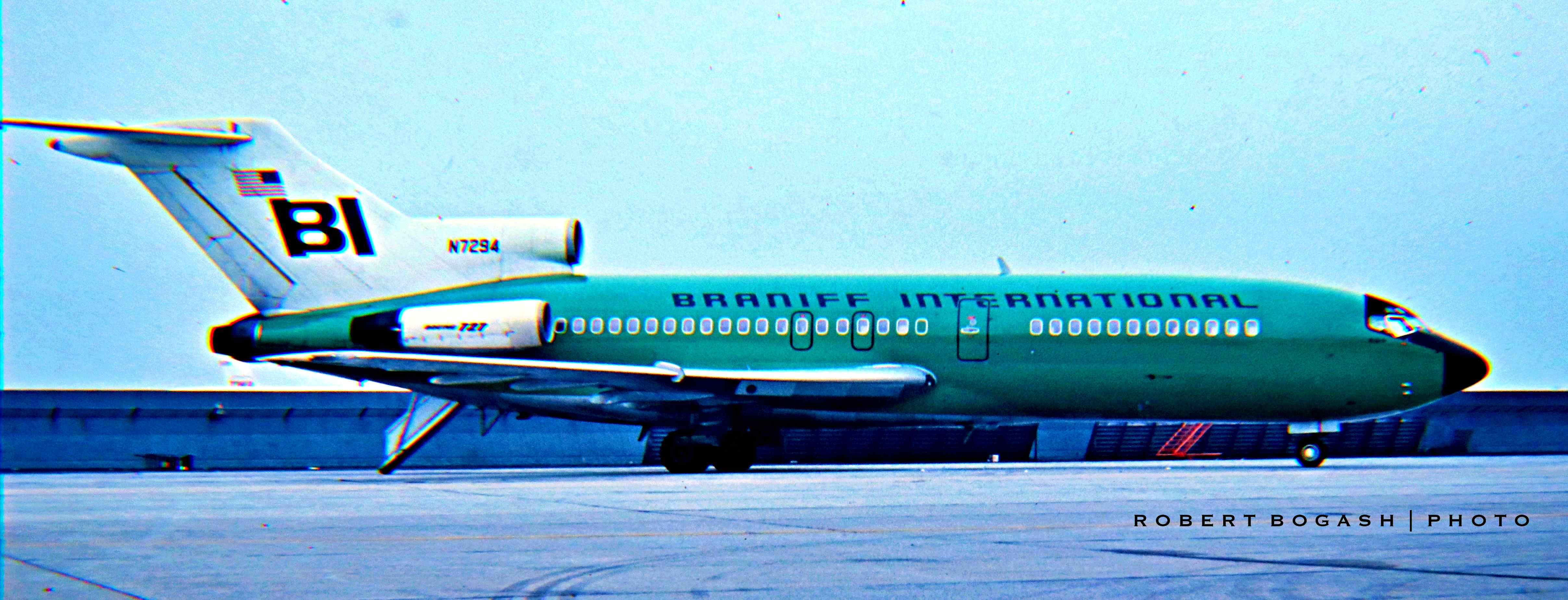   Delta CV-880    Like BOAC and Olympic, Aerolineas Argentinas transitioned from Comets to 707s   QF New Livery QF New Livery  720B     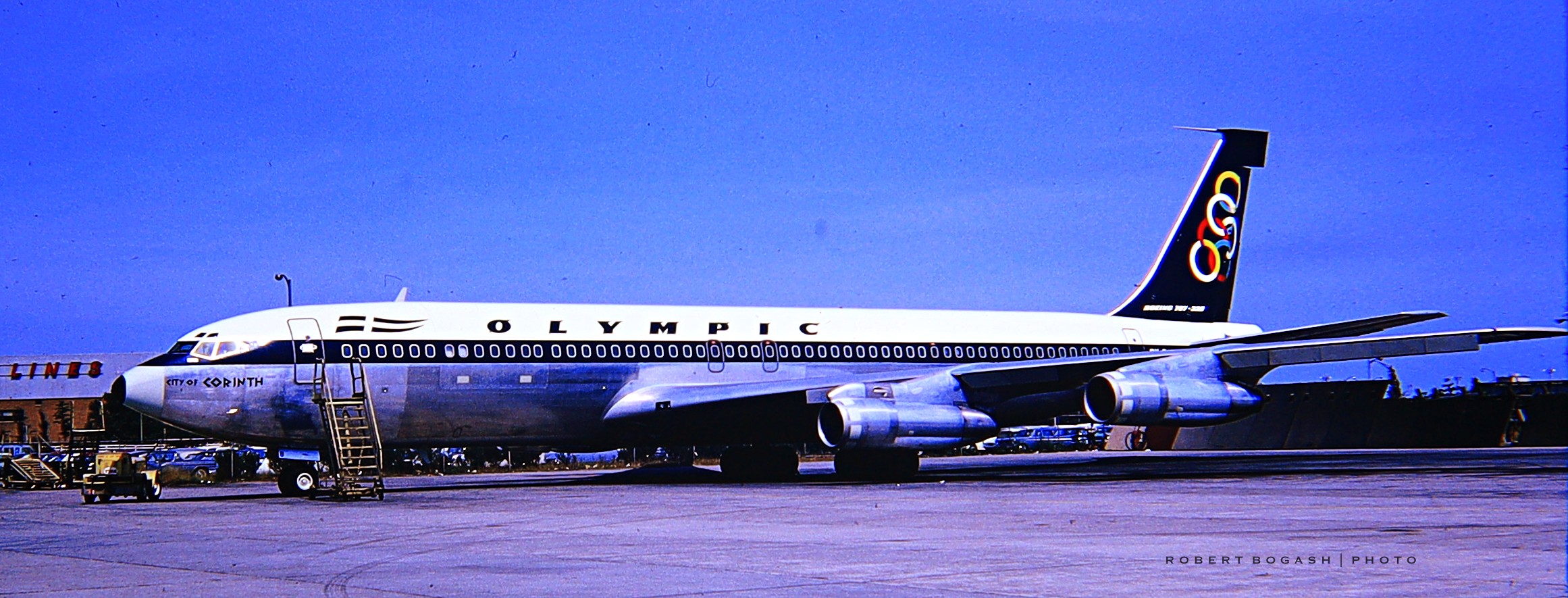       A World Airways 707 leased to El Al   ...and a World 727 leased to Air Jamaica   Question: Did Lufthansa ever operate DC-8s?
Note: This 720B below (D-ABOR) is one of 8 DLH 720B's, it later
went to Pan Am and Alia Jordanian. Two were lost in training
accidents.
Behind it is a DLH RR-powered 707-400. or were they 100% a Boeing operator? Answer: You're wrong again - yes they did - at least this one!  An Historic aircraft! This is the very first DC-8. Made it's first flight 30 May 1958. Was then used as flight test airplane being converted into several different DC-8 versions. Finally, it was used as a interim lease airplane to assorted airlines until finally, sadly, scrapped at Marana Arizona in 1993. Thanks to Mitch Grayson for the Heads-Up. OK - another one. Was KLM a CV-880 operator?  Better quit while you're ahead. Yup, they operated this one  Surprise!  ... jointly with Viasa - which had their paint job on the left side! Check the common registrations - service to Caracas.  While I was a Boeing
Rep in New York in 1968, I had an office in Pan Am Hangar 18 at JFK, and
was assigned responsibility for La Guardia and Newark Airports, and
also as the Primary Rep for two airlines based at JFK who were new First
Tier operators, taking new-build aircraft from the factory. They
were Seaboard World, introducing Boeing 707-320Cs, and Trans-Caribbean,
introducing 727-200s.
Seaboard  Here is one of their two 707s  .... and a DC-8-50F  .... and a DC-8-63CF Click here for my Seaboard story in detail. This
DC-8-63 was on its maiden arrival at JFK from the factory and then
departed for Japan on a USAF charter when it was intercepted by Russian fighters and
forced to land in the Kurile Islands.
Competing with Seaboard was their later merger partner - Flying Tiger Line from California. They both operated similar fleets - Connies, CL-44s, 707s and DC-8s.    This 707 - N322F - photographed at JFK in 1968 - was nick-named The Pole Cat.
  FTL - DC-8-63CF Trans Caribbean Trans-Carib operated primarily DC-8s, but also 707s (second hand) and also a mix of new and used 727s. Here is one of my 727s.  727-100  I took this picture 21 Sept 1968. I was flying 727-100 N531EJ (pictured above) from JFK to San Juan. The Flight Time was 3:05 The taxi time from OUT (push off the blocks) until OFF (Take-off) was 2:42. Yes - almost 3 hours and almost equal the length of the flight -- just to take-off! We sat in this long take-off queue with only one engine running to save fuel, while trying not to fill the cabin with the prior airplanes exhaust. Congestion ain't nothing "new"!  Trans-Carib 707    DC-8    Northeast flew both the Convair 880 (above) and the 990 (Below)     Aeronaves DC-8 taxiing SW. In the background is Runway 07R-25L. On 19 Jan 1961, an
Aeronaves DC-8 (perhaps this one?) was involved in a fatal runway
overrun accident departing to the NE on Rwy 07R. It was night time
and it was snowing. An Eastern check captain pulled the throttles
to Idle during the take-off run. There were four fatalities,
including the other three members of the cockpit crew. The Eastern
Capt survived.
The airplane overran
the end of the runway, crossed Rockaway Blvd (where I used to hang out
taking pictures!) and crashed and burned in a field north of the
highway. Large quantities of aircraft wreckage remained in that
location for years (perhaps still there); here is a souvenir piece I
recovered at a later date.

        An airplane in joint markings - National and Airlift I show this airplane also on my Renton Flight Line picture set.  PAL DC-8 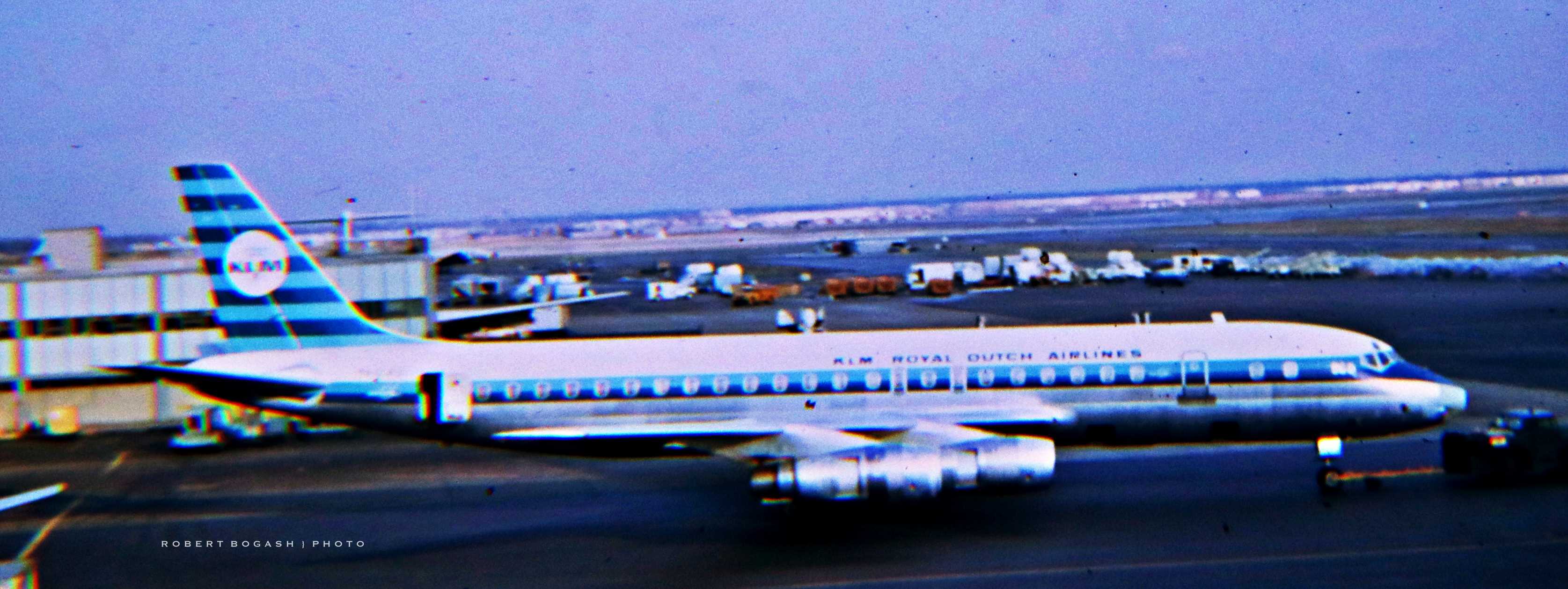  If you've got sharp eyes, you might notice these two DC-8s have different markings: Horizontal vs angled tail stripes Blue vs Red lettering.  KLM flying a Martin Air leased DC-8   Pan Am DC-8  Pan Am 707  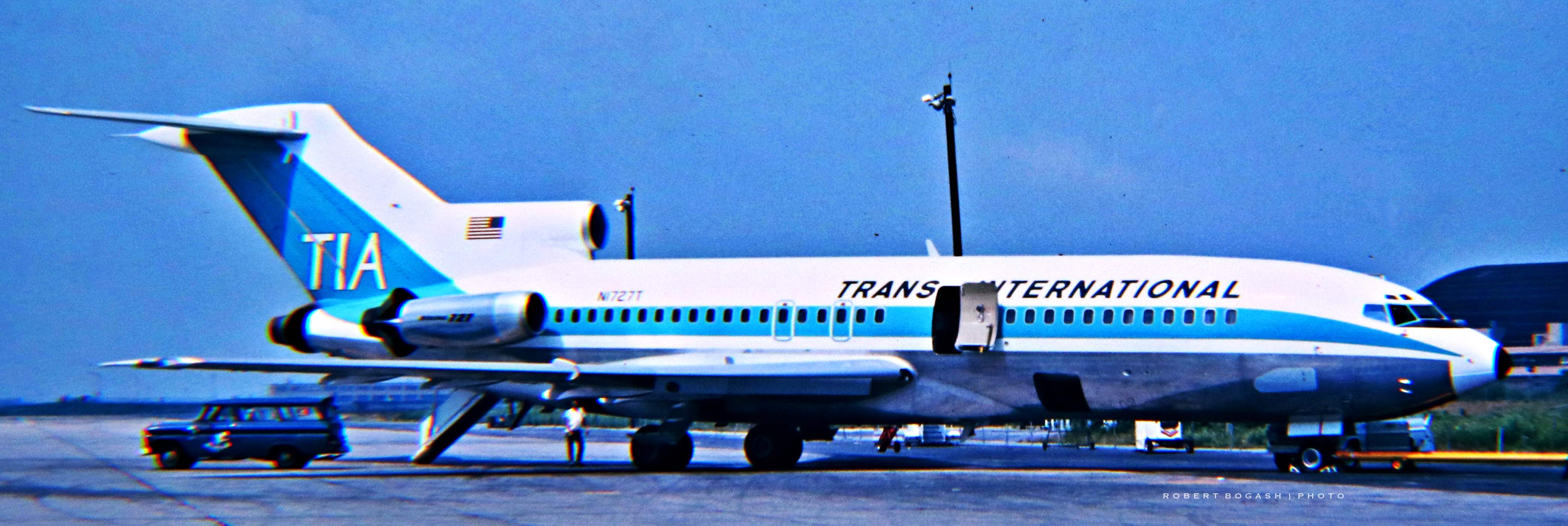  DC-8-61 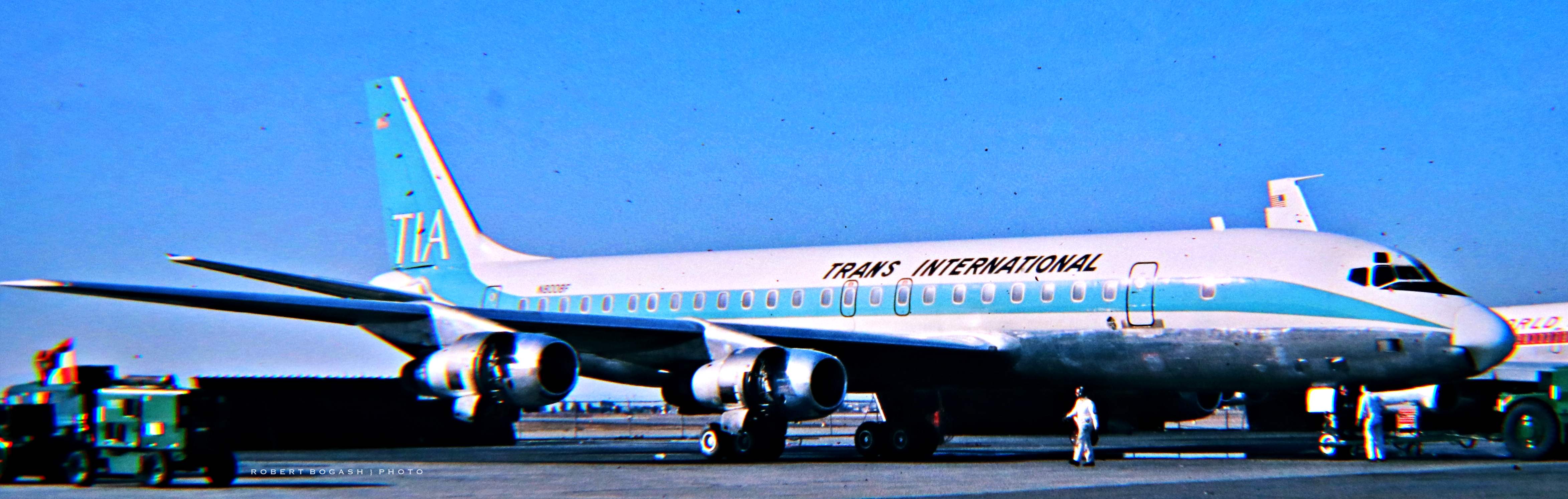 DC-8-50       I sincerely hope you have enjoyed this look back at times gone by at New York's Idlewild /JFK Airport Idlewild / JFK Page 1 - Props Airports and Airlines Photo Home Page Website Home Page |
||
|
Copyright 2024 Robert Bogash.
All Rights Reserved
|
